- Jun 25, 2025
Senate halts state AI rules as Jersey eyes blockchain security-Vol. 6, #25
- TekBeacon Core Technologies
- TekBeacon Signals Archive
- 0 comments
AI & Machine Learning
Senate advances AI regulation moratorium for ten years 🏛️

At a Glance:
The U.S. Senate advanced a decadal moratorium on state AI regulations, led by Senator Cruz, raising concerns about public safety and state rights amid AI management debates.
● The U.S. Senate has advanced a moratorium on state-level AI regulations for a decade to ensure national consistency.
● The provision, initiated by Senator Ted Cruz, threatens funding for states that regulate AI during this period.
● Concerns from Republican senators reflect ongoing debates about state rights and public safety in AI regulation.
● The moratorium may undermine state-level protections, complicating the balance between national and local regulatory needs.
Why this matters:
The Senate's progression of a decade-long moratorium on state AI regulations brings to the forefront critical discussions about balancing national consistency with the rights of states. This legislation, while aimed at unified governance, risks eliminating vital local protections that address unique community concerns over AI safety. Additionally, the tussle among senators implies potential fractures within the Republican Party, highlighting the complexity and urgency surrounding the need for effective and responsible AI regulation at all levels. The outcome of this debate will significantly shape the future of AI governance in the U.S.
Blockchain
Jersey explores blockchain for enhanced cybersecurity resilience 🔒

At a Glance:
Jersey seeks to enhance cybersecurity through blockchain technology to protect critical infrastructure, though financial and technical challenges remain. Leadership is crucial for successful implementation and resilience.
● Jersey faces significant vulnerabilities to cyberattacks, with outdated systems compounding the issue in recent incidents.
● Blockchain technology is proposed as a solution to enhance cybersecurity for critical infrastructure in Jersey.
● There are financial constraints and a lack of technical expertise hindering Jersey's full adoption of blockchain.
● Leadership from advocates like Ian Gorst is essential for developing Jersey's blockchain-enabled cyber resilience strategy.
Why this matters:
Jersey's exploration of blockchain technology as a cybersecurity solution illustrates a proactive approach to combating modern threats. However, the challenges of adoption highlight the importance of leadership and investment in technical expertise. By overcoming these hurdles, Jersey could set a precedent for small jurisdictions globally, fortifying not only its own critical infrastructure but also paving the way for advanced cybersecurity strategies that utilize innovative technologies in the financial sector and beyond.
IoT
China Mobile envisions AI-driven societal transformation 🌐

At a Glance:
China Mobile's chairman unveiled the "AI+" era, predicting intelligent machines will transform industries and society, outnumber humans, and enhance decision-making — with future networks like 6G supporting this evolution.
● China Mobile's chairman Yang Jie introduced the "AI+" era, emphasizing AI's role in societal transformation.
● Yang predicts intelligent machines will enhance decision-making and potentially outnumber humans in the workforce.
● Future technologies like 6G are expected to support ultra-low latency communication for optimizing AI systems.
● China Mobile aims to lead in AI, focusing on ethical development and collaboration with multiple sectors.
Why this matters:
China Mobile's push towards an "AI+" era signifies a profound shift in how technology integrates into our daily lives and industries. With intelligent systems set to reshape decision-making landscapes, the potential for increased economic efficiency and societal benefits is high. However, this transition necessitates ethical considerations and collaboration across sectors to ensure that these advancements enhance human capabilities rather than replace them, marking a critical point in the evolution of both technology and society as a whole.
Quantum Computing
India's largest quantum computer launched in Andhra Pradesh! 💻

At a Glance:
Tata and IBM are launching India's Quantum Valley Tech Park in Andhra Pradesh, featuring a powerful quantum computer that aims to revolutionize industries and enhance the state's innovation status.
● The Andhra Pradesh government is partnering with Tata and IBM to establish India's Quantum Valley Tech Park.
● The IBM Quantum System Two will feature a 156-qubit processor, becoming India's most powerful quantum computer.
● This initiative aims to transform sectors like life sciences and energy efficiency through practical quantum computing applications.
● The project seeks to attract investment and talent, positioning Andhra Pradesh as a global leader in quantum technology.
Why this matters:
The establishment of India's largest quantum computer in Andhra Pradesh not only signifies a leap in technological capabilities but also strategically positions the region as a leader in the global quantum race. With potential applications across key industries, this initiative is likely to drive job creation, attract investment, and foster innovation, while aligning with India’s National Quantum Mission. As quantum computing advances, the project's success could catalyze significant economic growth and influence the future landscape of technology in India, emphasizing the importance of state-corporate collaboration in shaping emerging industries.
Robotics & Automation
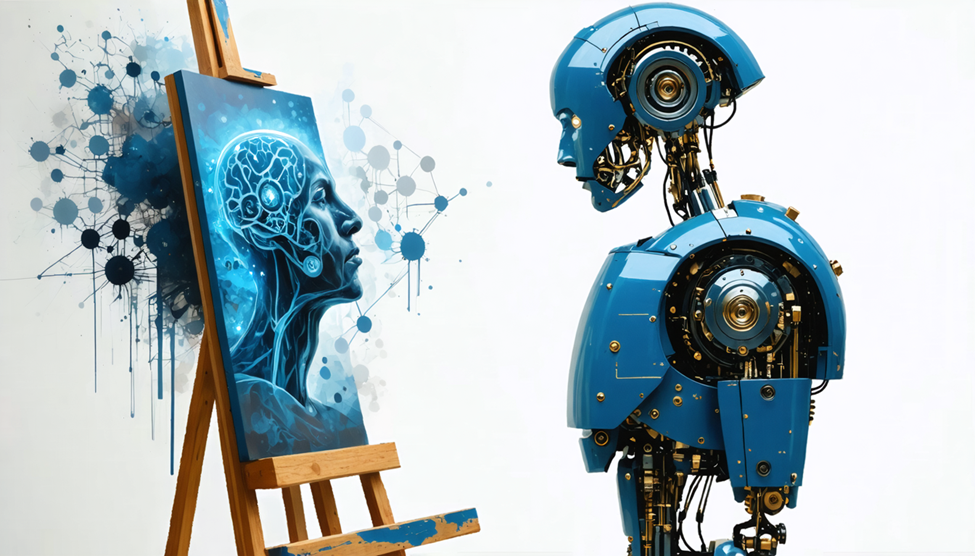
Automated robot artist created by former engineer 🎨
At a Glance:
Paul Kirby, a former Air Force engineer, created Dulcinea, a 10-foot automated robot that produces original artwork, merging art with engineering and prompting discussions on creativity's evolution alongside technology.
● Paul Kirby, a former Air Force engineer, developed Dulcinea, a 10-foot tall automated painting robot.
● Dulcinea creates original artwork from scratch, utilizing advanced technology and meticulous programming for intricate results.
● Kirby promotes "Fusioneering," advocating for the integration of art and engineering to enhance creativity with robotics.
● Dulcinea challenges traditional views of creativity, encouraging dialogue on the evolving relationship between art and technology.
Why this matters:
Paul Kirby’s creation of Dulcinea reflects a crucial intersection between art and technology, redefining creativity in the 21st century. By demonstrating that robotics can produce original artwork, Kirby encourages society to embrace machines as collaborators in self-expression. This shift not only fosters innovation but also compels us to rethink the evolving roles of technology in creative fields, prompting discussions on the balance between human artistry and machine efficiency in a rapidly mechanizing world. Such a partnership might lead to new forms of artistic expression that were previously unimaginable.
Nanotechnology
Gene therapy and nanotech improve diabetic retinopathy treatment 🌟

At a Glance:
Researchers are combining gene therapy with nanotechnology to develop less invasive and more effective treatments for diabetic retinopathy, potentially improving patient outcomes and quality of life significantly.
● Researchers are combining gene therapy and nanotechnology to enhance treatments for diabetic retinopathy (DR).
● Current interventions for DR are invasive and require regular administration, necessitating new treatment strategies.
● Innovative delivery methods like subretinal injections are being evaluated for improved patient outcomes and reduced frequency.
● The integrated approach may provide lasting solutions, significantly improving the quality of life for those with DR.
Why this matters:
The synergy between gene therapy and nanotechnology has the potential to revolutionize treatment for diabetic retinopathy, a condition poised to affect 160 million people by 2045. By focusing on less invasive delivery methods and targeting disease mechanisms earlier, these innovations promise more effective solutions that could significantly enhance patient quality of life. As current treatments are cumbersome, this integrated approach may serve as a model for future therapeutic strategies in other chronic diseases as well.